Los Angeles may have finally figured out how to build affordable housing, fast
Executive Directive One was designed to help tackle the city’s massive housing shortage by streamlining the approval process.

[Photos: halbergman/Getty Images, nespix/Getty Images]
On a lot in L.A.’s Echo Park neighborhood, developers planned to construct an apartment building with 38 luxury units. But now they’re building a 92-unit, 100% affordable building instead.
As interest rates rose last year, the cost of the original project became prohibitive. And a directive from Los Angeles Mayor Karen Bass—passed the week she took office in late 2022—suddenly made affordable housing economically feasible for developers who hadn’t considered building it before.
The order, known as Executive Directive One or ED1, was designed to help tackle the city’s massive housing shortage by streamlining the approval process. By one estimate, L.A. needs 270,000 new affordable housing units to meet demand. In broader L.A. County, more than 75,000 people are homeless. Previous efforts moved very slowly, despite large investments.
“When Mayor Bass came in and made this emergency declaration, the number-one thing she did—and as someone who’s been doing affordable housing for a long time, it’s incredible this is what it took—is she just told every city department ‘This is your priority, and these projects have to go to the front of the line,’” says Andrew Crane, a partner at Aero Collective, an architecture firm that is developing projects using ED1.
[Image: Aero Collective]
The directive started to work quickly: More than 16,000 proposed units have been approved by the city since it was put in place—more than the total approved in the past three years combined. By contrast, a $1.2 billion bond measure passed by voters in 2016 may end up building only 8,000 housing units over a decade.
Most of the new projects proposed under the directive are privately funded and don’t rely on subsidies. Rents will be capped to meet local requirements for affordability in the city—under the current rent schedule, a single person making around $70,000 per year would pay $1,766 per month for a studio apartment in Los Angeles; someone making $26,000 would pay $663.
The policy requires the city planning department to fast-track approvals for 100% affordable housing developments, reviewing applications within 60 days. Buildings don’t have to go through city council or neighborhood meetings, environmental review, or other discretionary hearings, which could easily take a year or more.
“Politicians can’t get in the way of it,” says Scott Epstein, policy director at the housing advocacy group Abundant Housing LA. After the projects are reviewed by zoning administrators, “if it checks all the boxes, it moves forward.”
After the planning and zoning approvals, building and safety approvals might take another six months. The whole timeline is “practically unheard of within the state of California,” says Muhammad Alameldin, a researcher at the Terner Center for Housing Innovation at the University of California, Berkeley. Typical construction projects can take years to approve.
The usual process is slowest for affordable housing, since developers have to combine multiple sources of funding. “One funding source depends on another funding source,” Epstein says. “You have to gather four or five or more pots of money while time is ticking. You’re spending money on your expeditors and the cost of construction is going up. It’s an inefficient system.”
With the streamlined process, the costs of a project drop. There’s also less risk that a project might hit a roadblock and not move forward. After the executive directive launched, “we started to realize how well it worked,” says Andrew Slocum, one of the developers behind the new building in Echo Park. “We started to look at what our unit count would look like. And with the [affordable] units, how the project looked much more viable versus market-rate luxury housing.” Slocum and his partners are planning to construct two other buildings under ED1, aiming to complete them by September.
Developers use ED1 in combination with state laws that are designed to boost affordable housing. One law lets developers add more units than zoning would otherwise allow; the increase in total rent from the extra apartments helps the projects work financially. ED1 also allows developers to ask the city for a large number of waivers from the local building code.
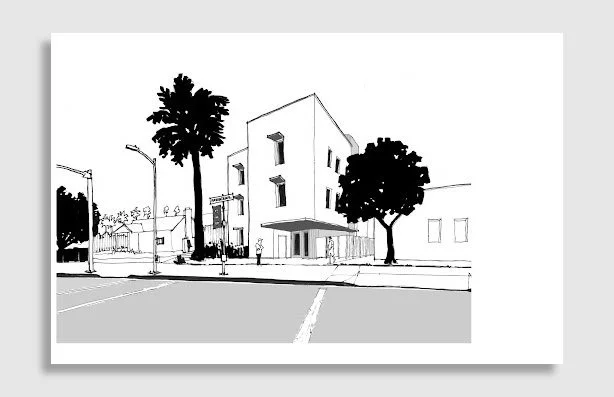
For a 15-unit supportive apartment building that Aero Collective plans to build in a low-income neighborhood in South Los Angeles on a lot where a house had burned in a fire, it requested 10 waivers—for example, it won’t use certain higher-end materials that would have otherwise been required. That doesn’t mean they’re cutting any corners on safety. “Our project is very, very simple,” Crane says. “Our goal here is just to build affordable housing, and we have to do it as cost-effectively as possible to get these projects to work.”
Aero Collective looked for other ways to shrink the time it would take to construct the building. The local power department can be a bottleneck when a building is large enough to need new electric infrastructure added in the street; Aero chose to build 15 apartments specifically so that it could work with the existing power lines. And the design was carefully planned so that the building needs only one staircase, rather than two staircases or an elevator.
Another state law says that any building within a half mile of public transit no longer needs to offer parking, and eliminating parking also significantly reduces costs. The design is intended to be replicable, and the firm already has plans in the works to use a version of it on other city lots.
Crane previously worked primarily on affordable housing developments that got financing the traditional way, with tax credits, and found the pace—five or six years on the same project—agonizingly slow. But he says there’s still a place for that type of development, despite the much higher cost. Spending more brings other benefits: Buildings financed with tax credits require construction workers be paid the prevailing wage, for example, something that ED1 doesn’t require. (A prevailing wage is based on the average paid to workers on similar projects; ED1 projects have the option to pay less.)
There are also stringent sustainability requirements. In one tax credit project that Aero is working on, plans include resilience features like a cooling center for extreme heat and refrigerators on backup power in case the grid goes down, something that wouldn’t be affordable in a bare-bones project.
Crane says that an ED1 project can still be environmentally responsible. The South L.A. apartment building is all-electric, and replacing a burned-out single family home with 15 units is inherently a better use of space. Some are two- and three-bedroom units (rather than just studio apartments, like most new affordable housing), which could potentially help some families stay in a dense area with easy access to amenities rather than moving to a suburb where they can’t get around without a car.
ED1 isn’t perfect. After complaints about some projects proposed in single-family neighborhoods, the city changed course last year to say that it no longer applies in those neighborhoods. Lawsuits have challenged the idea that a mayor can use emergency powers for this type of directive, which was in effect for a year and then extended. Now, as the Los Angeles City Council considers how to make the directive a permanent ordinance, it’s likely to be a little watered down, with fewer waivers allowed. And it’s not clear yet how many of the proposed projects will be completed; Crane has concerns that some of the luxury developers who jumped into the space may not have truly viable projects.
But it’s still a powerful tool, and one that could be useful in other California cities, including the many smaller cities that make up L.A. County. “Our office is in Inglewood,” Crane says. “So it feels like we’re in L.A., but we’re in a different city, so we can’t do ED1, even though I see a lot of opportunity for it.”
Crane hopes that the design for Aero’s first project could be preapproved by the city—in the same way that L.A. has preapproved some designs for backyard accessory dwelling units—so that anyone could use it and it would take even less time to build. Speed in the current housing crisis is an obvious need. “We just want to bring housing to market really, really quickly,” he says. “That’s our ultimate goal. We all drive by people on the street every day.”